
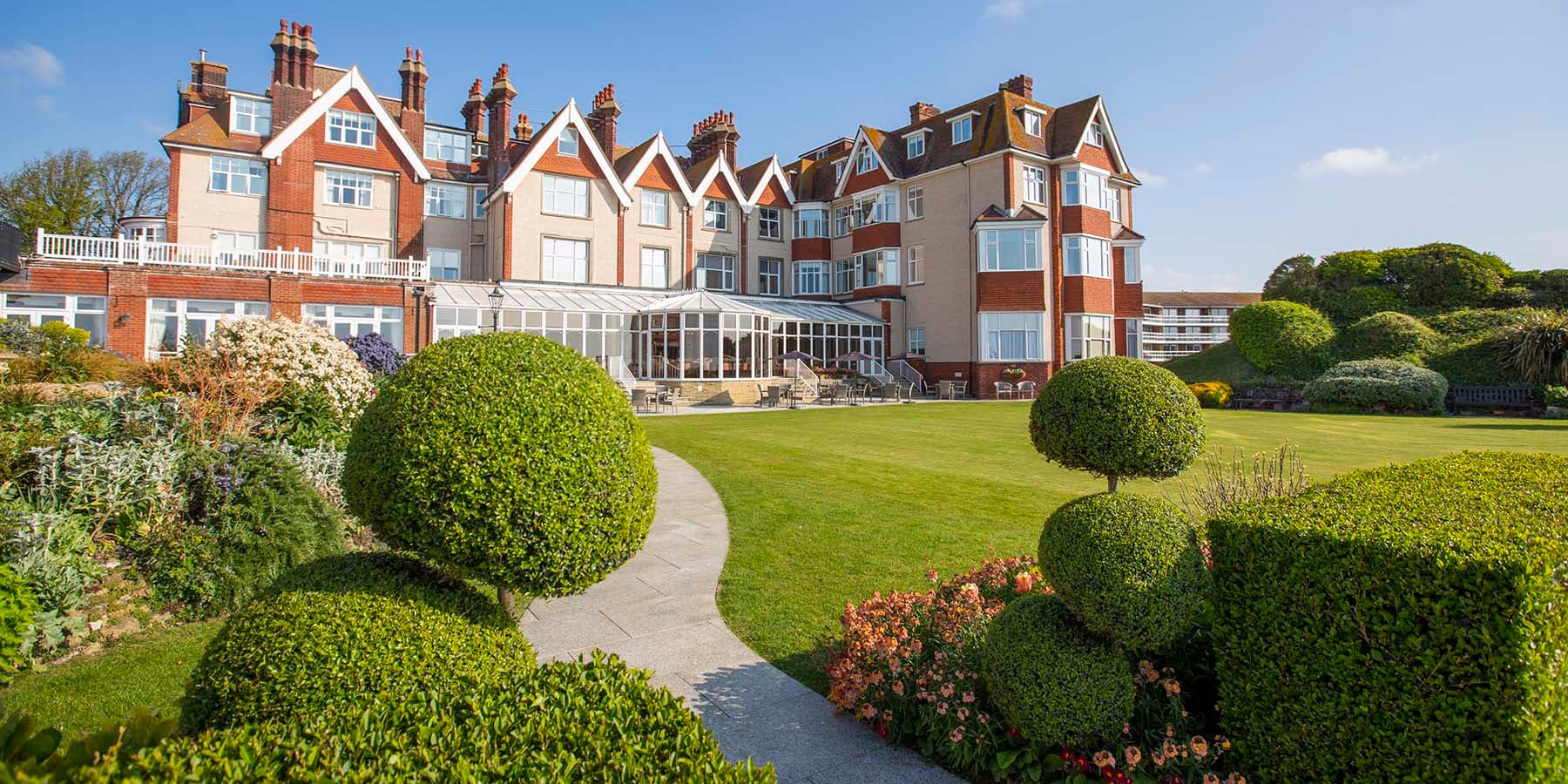

Hydro Hotel is one of Eastbourne's best-known independent hotels — set in private grounds on the seafront, combining traditional hospitality with the operational demands of a modern guest environment. Bedrooms, dining, events, staff mobility, business systems, guest Wi-Fi, CCTV, telephony, cloud services and cyber security all need to work reliably in the background, often unnoticed.
What we found was technology that had grown up over many years. Different systems installed at different points by different suppliers, with very little joining them up. Four separate networks doing what one would now do — Wi-Fi, corporate systems, telephony and cameras each running on their own. Patchy guest wireless covering only parts of the building. An older analogue camera estate tied to its own dedicated cabling. Network switching well behind modern speeds. And an aging on-site server still carrying work that today would naturally sit in the cloud.
M-Tech worked with the hotel as a complete technology environment, not a list of unrelated systems. A modernisation programme that has progressively replaced the foundation: managed networking and structured cabling, surveyed Wi-Fi across the hotel and gardens, IP CCTV, cloud migration, layered cyber security and most recently a cloud-hosted 3CX telephony platform across all 100 guest bedrooms — delivered around live operations rather than in spite of them.
What hospitality technology actually has to do
- Context:
Guests notice it when it fails — Wi-Fi, telephony, room comfort and online services are background expectations, until they're not
- Context:
The building stays open — modernisation has to happen around bookings, events, dining and staff routines, not instead of them
- Context:
Hospitality has its own telephony shape — reception, offices, mobile staff, corridors, emergency use and bedroom phones are five different requirements pretending to be one
- Issue:
Silos compound, they don't simplify — separate networks for Wi-Fi, corporate, phones and CCTV feel cleaner up front; they get fragile, expensive and supplier-tangled fast
- Context:
CCTV is now an IT system — once it leaves coax for IP, it depends on cabling, network design, segmentation and security like any other connected device
- Goal:
Cyber security has to fit a small operations team — managed, layered and supportable, not a stack of consoles only an enterprise SOC could love
What we delivered
Replaced four separate physical networks with one managed, VLAN-segmented platform — guest Wi-Fi, corporate systems, telephony, CCTV and operational devices sharing the same cabling and switching, kept logically apart where it matters. Legacy unmanaged 100Mbps switching swapped for managed gigabit in strategic locations.
Hotel internet provided over a Lightning Fibre gigabit service — leased-line-grade speeds and SLA at the price of a typical business connection, rather than the leased-line bill that usually comes with that performance. As one of their top partners, M-Tech has a direct line into their network operations — faults and outages go straight to the right people rather than through a generic support queue.
Professional wireless design across the estate — bedrooms, corridors, restaurant, orangery, bar, lounges, offices, event spaces and outdoor garden areas. 35 access points planned to deliver consistent coverage rather than the sparse 2.4GHz bleed-through the hotel had been making do with.
Twelve IP cameras across the north-east wing covering ingress, egress and corridor lines on the first, second and third floors — the first move away from a fully analogue, coax-bound estate, with the rest of the camera estate to follow.
A complete server retirement and cloud move — Microsoft 365 productivity, modern device management, MFA and Conditional Access, email domain security, security tooling and migration of user and shared data into cloud storage and collaboration. A change of operating model, not just a change of tooling.
Managed endpoint detection and response, application control and privilege management, phishing and dark web monitoring, password and breach monitoring, cloud and server backup, and ongoing cyber hygiene services — built around the size and shape of the hotel's operations team.
A new cloud-hosted 3CX phone system on M-Tech's resilient Nutanix cloud — reception and office desk phones, a DECT system for managers and mobile staff, and 100 Fanvil Wi-Fi handsets in the bedrooms riding the surveyed wireless estate, with room billing posted straight into the hotel PMS. One managed telephony platform across the whole hotel.
Ongoing IT support and management across the modernised estate — productivity, identity, devices, security tooling, backup, telephony and the network underneath it. One service desk, one accountable partner, documentation that exists.
Everything depends on everything else
Most providers can quote a Wi-Fi system, a phone system, a firewall, a cloud migration or a managed support contract in isolation. The harder skill is seeing what they all depend on.
A hotel phone system depends on the network. Guest Wi-Fi depends on structured cabling, switching, internet provision and proper wireless design. CCTV — once it leaves coax — depends on physical coverage, power, cabling, network segmentation and secure remote access. Cloud migration depends on identity, endpoint management, data structure, backup and security tooling. Managed IT support depends on documentation, monitoring and standards that exist before they're needed.
At Hydro the physical layer, the network layer, the security layer, the cloud layer, the telephony layer and the managed service layer were brought into one programme, accountable to one relationship. The result isn't just less hassle. It's a practical path from legacy to modern that wouldn't have survived being split across three suppliers.
Wi-Fi is a discipline
Wi-Fi looks deceptively simple. Put a few access points up, give it a name, off you go. The reality is a physics problem — radio signals don't politely fill a room the way light does. They bend, bounce, weaken through walls and furniture, and behave differently in every part of a building. Done well, Wi-Fi disappears. Done badly, you get exactly what Hydro had: barely-there coverage and the kind of speeds that a single guest streaming Netflix would saturate.
Our wireless work is designed and validated using Ekahau — the industry-standard survey and planning toolset. Predictive modelling before a single AP is mounted, then on-site validation after deployment to confirm what the model promised actually happens. For Hydro that produced a designed plan covering bedrooms, corridors, restaurant, orangery, bar, lounges, offices, event spaces and outdoor garden areas — 35 access points placed where the RF behaviour of each space called for them, not where there was a convenient ceiling tile.
It's worth saying this once. The radio side of Wi-Fi isn't part of an electrician's training. It isn't part of a telecoms installer's training. Even an IT support outfit may understand the wired side of a network without understanding the wireless side. Designing Wi-Fi at the scale of a large hotel is its own discipline — and it deserves specialists who do this work full time. In a hotel, where guests now quietly grade the place partly on whether their video call survives the walk to the lobby, that distinction matters.
That investment shows in places that aren't obvious. The hotel's old copper bedroom phones have now been replaced with Wi-Fi handsets — only practical because the wireless underneath them is properly designed, and a quietly substantial saving in bedroom-by-bedroom cabling. That telephony deployment is worth its own look.
Telephony, shaped for a hotel
A hotel is not one phone system. Reception and back-office desks, managers and staff who spend the day moving around the building, and a phone in every guest room are three different jobs pretending to be one — and the recently-deployed platform answers all of them from a single system: 3CX, hosted on M-Tech's own resilient Nutanix cloud rather than a box in a comms room, so the phones inherit the same resilience and management as the rest of the estate.
The handsets are matched to the job rather than bought one-size-fits-all:
- A bedroom phone in every room, over the Wi-Fi. All 100 guest bedrooms run Fanvil H4W Wi-Fi handsets on the surveyed wireless network. This is only possible because the Wi-Fi was designed properly first — the coverage is now good enough that the rooms no longer need their old copper phone wiring at all. Retiring an entire legacy cabling estate because the wireless underneath it is strong enough to carry the phones is a genuinely unusual outcome, and a real saving.
- The few the Wi-Fi couldn't reach — Fanvil 2-Wire. For the handful of rooms and spots where a Wi-Fi handset wasn't the right answer, we used Fanvil's 2-Wire units, which carry both Ethernet and Power-over-Ethernet down a single existing copper pair. A neat bit of engineering that reuses the wire already in the wall instead of pulling new cable to those rooms.
- Managers and mobile staff — Yealink DECT. A 15-base-station Yealink DECT system with fifteen handsets, giving senior managers and roaming staff proper coverage across the whole building rather than being tethered to a desk.
- Front-of-house and offices — Yealink T73W desks. Twenty Yealink T73W desk phones, four of them fitted with EXP50 colour expansion modules for the reception positions that need to see the status of a lot of extensions at a glance.
- Billing and PMS — Tiger iCharge Enterprise. Room calls are metered and posted straight into the hotel's property management system, so charges reconcile automatically rather than by hand.
The point isn't the brand names. It's that a hotel's telephony has a specific shape — mobile, room-by-room, front-of-house and back-office all at once — and it was designed to that shape, on infrastructure M-Tech runs end to end.
Working in a live hotel
A hotel doesn't pause for an infrastructure refresh. Guests still need rooms. Events still happen. Staff still need to answer phones, take bookings, serve dinner and run the business. Any technology project has to be planned around that reality, not despite it.
That shaped how the work was delivered. Cabling, switching, access points, cameras, phones, cloud cutover and user changes were all coordinated around the hotel's operational rhythm — maintenance windows in appropriate hours, advance notice of planned interruptions, and contact procedures for the things that genuinely couldn't wait.
A technically correct solution that disrupts the guest experience or burdens the staff isn't actually correct. The hotel keeps running while the foundation gets rebuilt underneath it.
What's next
This isn't a finished story. The next CCTV phase, planned for later in 2026, takes the camera estate the rest of the way to a fully IP, AI-aware platform — intelligent classification of people and vehicles, more accurate detection, better searchability and a more scalable surveillance posture across the whole site, integrated with the same managed network and security layer as the rest of the estate.
The same broader trajectory continues across the managed service: cyber hygiene improvements, expanded automation, deeper integration between the systems the hotel actually depends on, and a roadmap for digital guest services as and when it makes sense for the business.
The foundations are now in a state where each next step is incremental rather than reinvention.
Platform at a glance
- Hotel
- Hydro Hotel — independent landmark on the Eastbourne seafront with private grounds
- Estate
- bedrooms, dining, lounges, orangery, bar, event spaces, offices and garden areas
- Network
- managed gigabit switching with VLAN segmentation — guest, corporate, telephony, CCTV and operational systems on one platform, kept logically apart
- Internet
- Lightning Fibre gigabit — leased-line-grade speeds and SLA at business-grade pricing, with M-Tech's partner-level escalation path into their NOC
- Wi-Fi
- 35 surveyed access points across hotel and gardens, with a branded guest access experience
- CCTV
- phase 1 delivered (12 IP cameras across the north-east wing); phase 2 — full IP, AI-aware — planned for later 2026
- Cloud
- Microsoft 365 productivity, modern device management, MFA + Conditional Access, email domain security; onsite server retired
- Security
- managed EDR, application control & privilege management, phishing and dark web monitoring, password and breach monitoring
- Backup
- cloud and server backup wrapping critical business data
- Telephony
- cloud-hosted 3CX on M-Tech's resilient Nutanix cloud — 20 Yealink T73W desk phones (4 with EXP50 colour expansion modules), a 15-base Yealink DECT system with 15 handsets for managers and mobile staff, 100 Fanvil H4W Wi-Fi bedroom handsets on the surveyed wireless estate (plus a few rooms on Fanvil 2-Wire, reusing existing copper for Ethernet and PoE), and Tiger iCharge Enterprise room billing integrated with the hotel PMS
- Managed service
- ongoing IT support and security across the whole estate, single point of accountability
- Distinctive
- a fragmented, multi-supplier estate brought under one accountable partner without pausing live hospitality
M-Tech have helped us modernise Wi-Fi, networking, CCTV, cloud, cyber security and telephony — practical, joined-up work from a partner that understands the demands of a live hotel. We'd happily recommend them to other hospitality businesses.
What changed
Joined-up estate
Wi-Fi, network, CCTV, cloud, security, backup, telephony and support — under one accountable partner instead of a patchwork of suppliers, with documentation, monitoring and standards that actually exist.
Wi-Fi guests can rely on
Sparse 2.4GHz bleed-through replaced with a surveyed, modern wireless deployment across the whole hotel and the gardens. Coverage matches the way guests actually use the building.
Off the server, into the cloud
Onsite server dependency retired in favour of Microsoft 365 identity, cloud storage, modern device management and MFA-protected access. A different operating model, not just different tooling.
Modernisation without disruption
Cabling, switching, cameras, phones and cloud cutovers coordinated around live hospitality — guests, events and staff routines stayed front and centre throughout the programme.
In numbers
- 02 / 04Wi-Fi access points designed across hotel and gardens0
- 03 / 04IP cameras delivered in CCTV phase 10
- 04 / 04Lightning Fibre symmetrical internet, partner-grade SLA0Gbps
A foundation for what comes next
Hydro Hotel didn't need a single product fix. It needed a coherent technology foundation — physical, network, Wi-Fi, cloud, security, telephony and managed service — designed around the way a busy independent hotel actually operates.
That programme is now in place. Wi-Fi covers the building and gardens. The network is one managed, segmented platform instead of four. Cameras have started the journey from analogue to AI-aware IP. The onsite server is retired, replaced by Microsoft 365, MFA and modern device management. The phones are cloud-hosted 3CX across all 100 bedrooms and every operational seat. Security is layered, monitored and managed.
The result is a hotel whose technology supports the work rather than getting in the way of it — and a foundation flexible enough to absorb whatever comes next, from phase 2 CCTV to digital guest services, without starting over.