
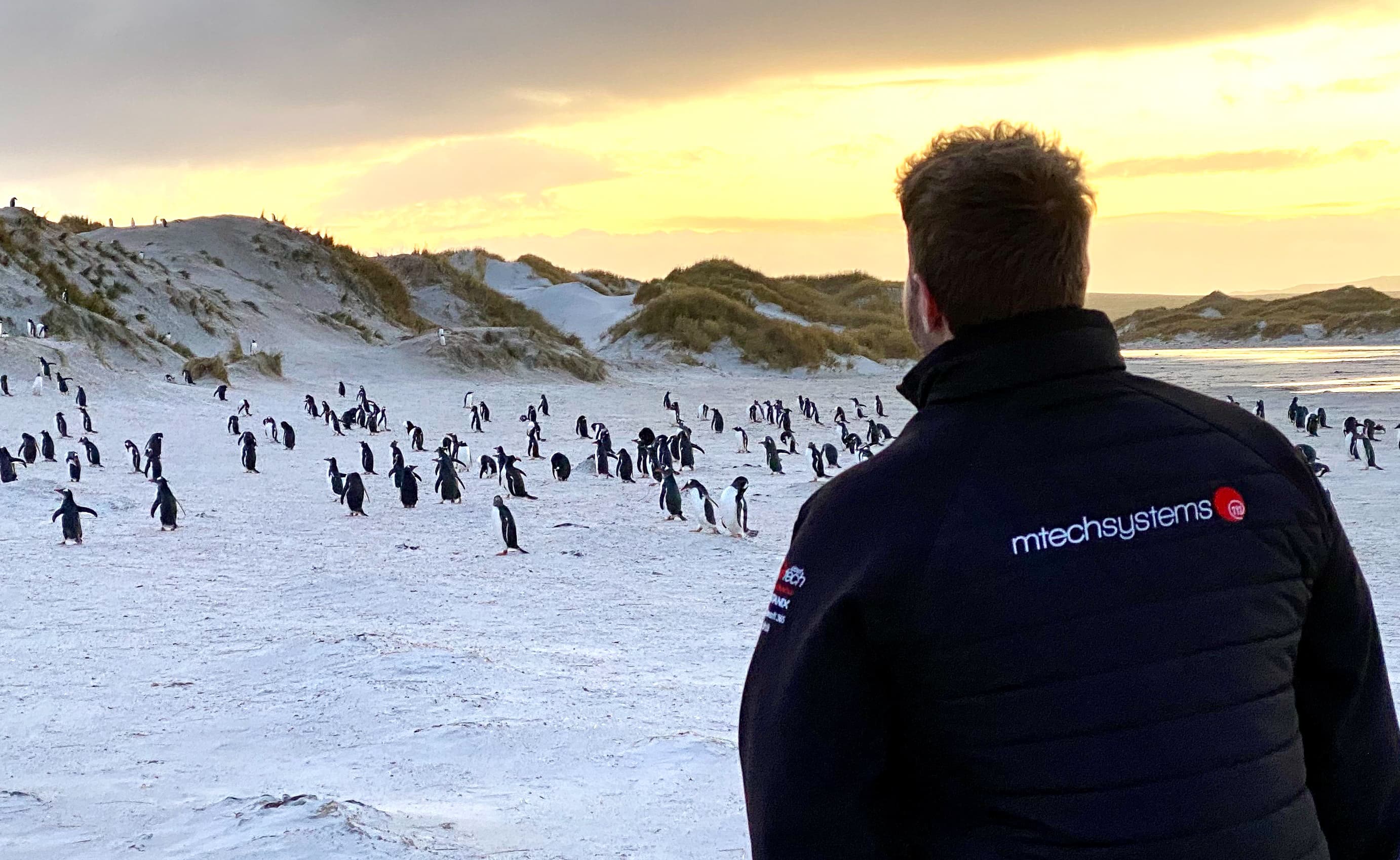

When your data centres are 8,000 miles from the UK mainland, infrastructure problems are not just "IT issues". They become operational issues.
The Falkland Islands Government (FIG) runs critical public services from a remote territory with unique constraints: limited access to replacement parts, complex logistics, and very little tolerance for platform instability. When their virtualisation estate began suffering repeated outages and persistent storage pressure, it was clear the existing architecture had reached its limit.
The objective was straightforward to describe but harder to deliver: stabilise the platform, remove the storage bottlenecks, simplify operations, and provide enough headroom to grow — without immediately buying more storage. And it had to be delivered in a way that worked in the real world: pre-staged where possible, shipped securely, built quickly on-island, and migrated with minimal disruption.
What was breaking
- Issue:
Reduced service confidence — outages became more frequent and harder to predict
- Issue:
Restricted growth — storage pressure limited the ability to expand services safely
- Issue:
Slower incident resolution — a complex multi-vendor stack and an increasingly messy storage fabric
- Issue:
Higher operational overhead — the on-island team spent more time firefighting and less time improving services
FIG did not want a partial fix. They wanted a platform change that would measurably improve stability, simplify operations, and create clear headroom for the next several years.
How we approached it
Before proposing a target design we ran a data-led sizing exercise using Nutanix Collector inside the live Hyper-V estate. That captured real utilisation across 130 virtual machines — CPU, memory, storage footprint and workload patterns through peak and off-peak periods. The replacement design was sized against real workload behaviour, not assumptions.
Discover
Nutanix Collector across 130 live VMs. Where was the platform under strain, and why? Real workload data, not vendor sizing tools.
Pre-stage in the UK
Hardware readiness checks, firmware updates, baseline configuration and validation testing — before a single rack unit left British soil.
Ship via RAF Brize Norton
Coordinated secure shipment under special arrangements. The equipment had to arrive on time and intact — measured in weeks, not days, if it didn't.
Deploy on-island
A 45-day professional services engagement: installation across both data centres, network integration, platform bring-up and structured knowledge transfer with the FIG team.
Migrate
Phased Hyper-V → AHV cutovers with hands-and-eyes on-island and remote engineering from the UK. Each wave validated before the next began.
Run
Four-year managed service wrapper. 2nd and 3rd line during business hours, 24/7 for critical issues. Operations resilience, not just technology resilience.
What we delivered
FIG selected a full transition to Nutanix hyperconverged infrastructure, delivered as an eight-node architecture split across the two data centres in Stanley.
Hyperconverged compute and storage, four nodes per data centre with integrated cross-site replication and snapshotting.
Hypervisor — moving off Hyper-V collapses a layer, gives a single control plane, and removes a major source of vendor grey areas.
Centralised management, analytics, capacity forecasting and automation. Proactive operations, not reactive firefighting.
Converged fabric core. 25Gb capable, 10Gb deployed initially — immediate uplift with a clear upgrade path.
Immutable backup repository plus offline tape retention. A modern platform is only as valuable as its recoverability.
We would like to extend our sincere thanks for the work you are doing. It is making a tangible difference, and the Falkland Islands are fortunate to now have the depth of expertise needed to strengthen and stabilise our infrastructure.
What changed
The platform shifted from "fragile and reactive" to stable and predictable, with near-zero unplanned downtime since cutover.
Stability
Fewer failure points. Storage bottlenecks removed. The fabric that used to amplify incidents now contains them.
Headroom
Capacity sized to real workload data — growth is planned, not forced by a SAN running hot.
Simplicity
One control plane for compute, storage and virtualisation. Cleaner troubleshooting. Cleaner support escalation.
Supportability
Fewer vendor grey areas during incidents. Issues isolated faster, resolved faster, and less likely to recur.
Platform at a glance
- Location
- Two data centres in Stanley, Falkland Islands
- Legacy platform
- Hyper-V three-tier architecture
- New platform
- Nutanix eight-node G9 — four nodes per site
- Hypervisor
- Migrated from Hyper-V to Nutanix AHV
- Network fabric
- Juniper EX4650 — 25Gb capable, 10Gb deployed
- Workload scope
- 130 VMs sized using Nutanix Collector
- Backup & DR
- Immutable repository plus offline tape
- Support
- Four-year managed service, 24/7 critical
In numbers
- 02 / 04VMs migrated0
- 03 / 04Unplanned downtime since0
- 04 / 04Nutanix nodes / 2 DCs0
Beyond the data centres
This programme sits within a broader, long-term partnership where the focus stays the same: improve service outcomes for FIG and reduce the operational friction that distance creates.
- Fully managed IT for FIG's London office
- Trusted technology supply partner — PCs, laptops, networking, AV
- End-to-end logistics and delivery chain
- 3CX telephony across on-island services
- Interactive touch display solutions
- Microsoft 365 licensing and commercial support
- Microsoft 365 E5 tenant hardeningin flight
- MDM for the education estateplanned
In short, FIG uses M-Tech not simply as an implementation partner, but as an ongoing technology partner: a single, accountable point of expertise that understands the island's constraints, priorities and pace.